

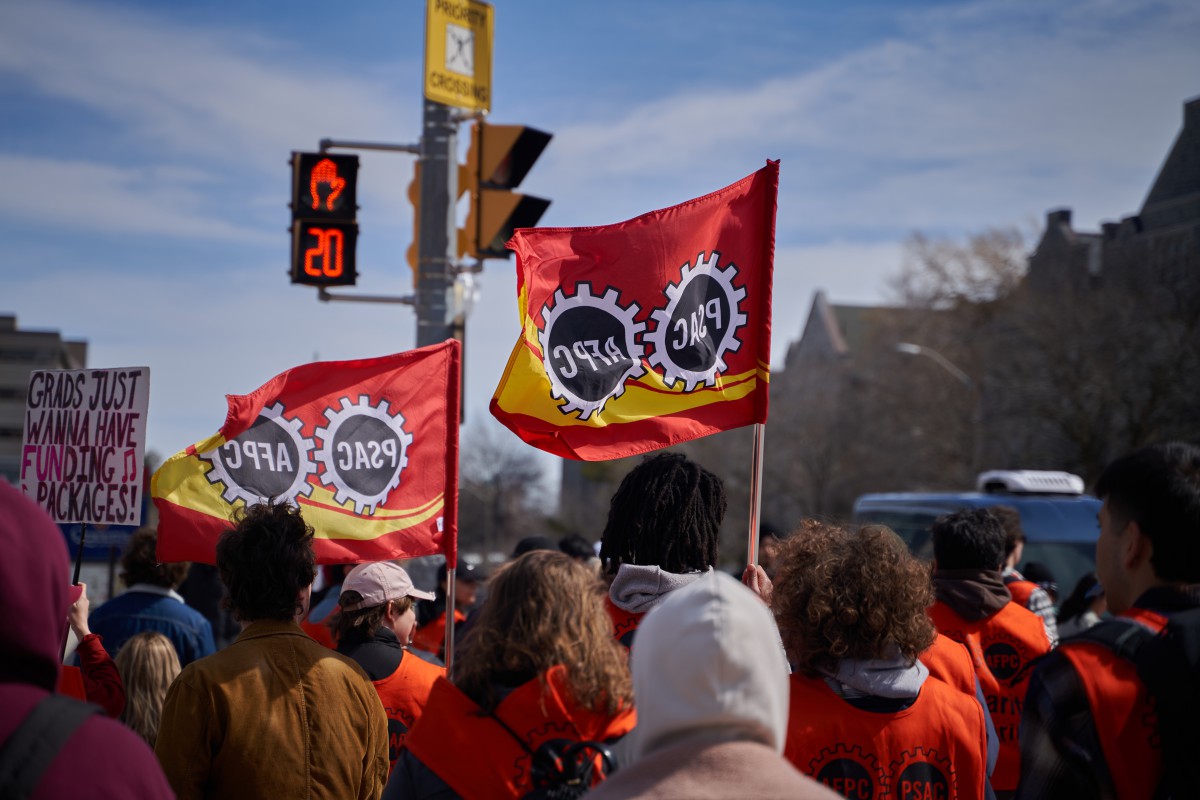
On March 10, 2025, at midnight, I went on strike for the first time in my life. I was not alone; in its nearly two decade-long history, my union, the Public Service Alliance of Canada Local 901 (PSAC 901), had never taken this form of labour action.
Together with fellow graduate student workers Rowan Li, Milka Njoroge, and Justyna Szewczyk-El Jassem, and two negotiators from PSAC, I was part of the team that negotiated the collective agreement for 2,000 graduate student workers at Queen’s University. Our unit, Unit 1, consisted of teaching assistants, research assistants, and teaching fellows. Unit 2, consisting of post-doctoral scholars, had finished their collective bargaining under threat of a university lock-out just months before. We knew we were up against an institution set on budget cuts and hiring freezes. Being on strike during a period of university-wide austerity measures would be difficult.
We were forced to walk away from the bargaining table, triggering what would be a six-week strike against unfair wages, inadequate compensation for our teaching fellows, a lack of retroactive pay for a year’s worth of stolen wages from an expired collective agreement, and the most perplexing issue of all: the employer’s consistent refusal to add caste as a ground for discrimination in our anti-discrimination clause, housed in Article 20.
Institutions of higher learning are not free from caste-based discrimination. In 2021, students at the University of California, Davis (UC Davis), found evidence of caste-based discrimination among students and self-organized to push the university to address caste-based discrimination.
The employer’s refusal to acknowledge a five-letter word in an already established clause initially confounded the bargaining team. We stayed up late at night poring over draft proposals and wondering why the employer was digging its heels in on this. The answer slowly became apparent as Queen’s continued to refuse to bargain in good faith: discrimination is part of the very foundation upon which Queen’s – a colonial project built as an attempt to cement British imperial presence in Canada – is established. Acknowledging caste-based discrimination not only unsettles this foundation by pointing out the inadequate policies in place to protect students and workers, but also compels the university to actively undo the elitism, classism, and racism that created its wealth.
Caste stratification
Sociologist André Beteille defines caste as “as a small and named group of persons characterised by endogamy, hereditary membership, and a specific style of life which sometimes includes the pursuit by tradition of a particular occupation and is usually associated with a more or less distinct ritual status in a hierarchical system.” Caste encompasses groups of people who inherit a certain social status at birth, which then directly affects everyday life by restricting who they can and cannot marry and their occupation. This system of social and economic stratification informs the structure of much of Indian – and specifically, Hindu – society. Casteism can be found in Indian Hindu diasporic communities in the West, where it becomes a distinct form of discrimination that is harder to recognize, albeit just as exclusionary and dehumanizing. Caste discrimination has elements of classism embedded within it, as it affects the types of occupation a person can obtain, their social status, and the economic conditions they inhabit. Yet, the totality of the caste system, in which caste identity informs daily behaviour (diet, speech, and social interactions with others), makes this form of discrimination pervasive and difficult to detect, especially in a Western/European context.
Faculty members and librarians joined the picke line, holding departmental signs in solidarity and support of graduate student workers on strike. Photo provided by author.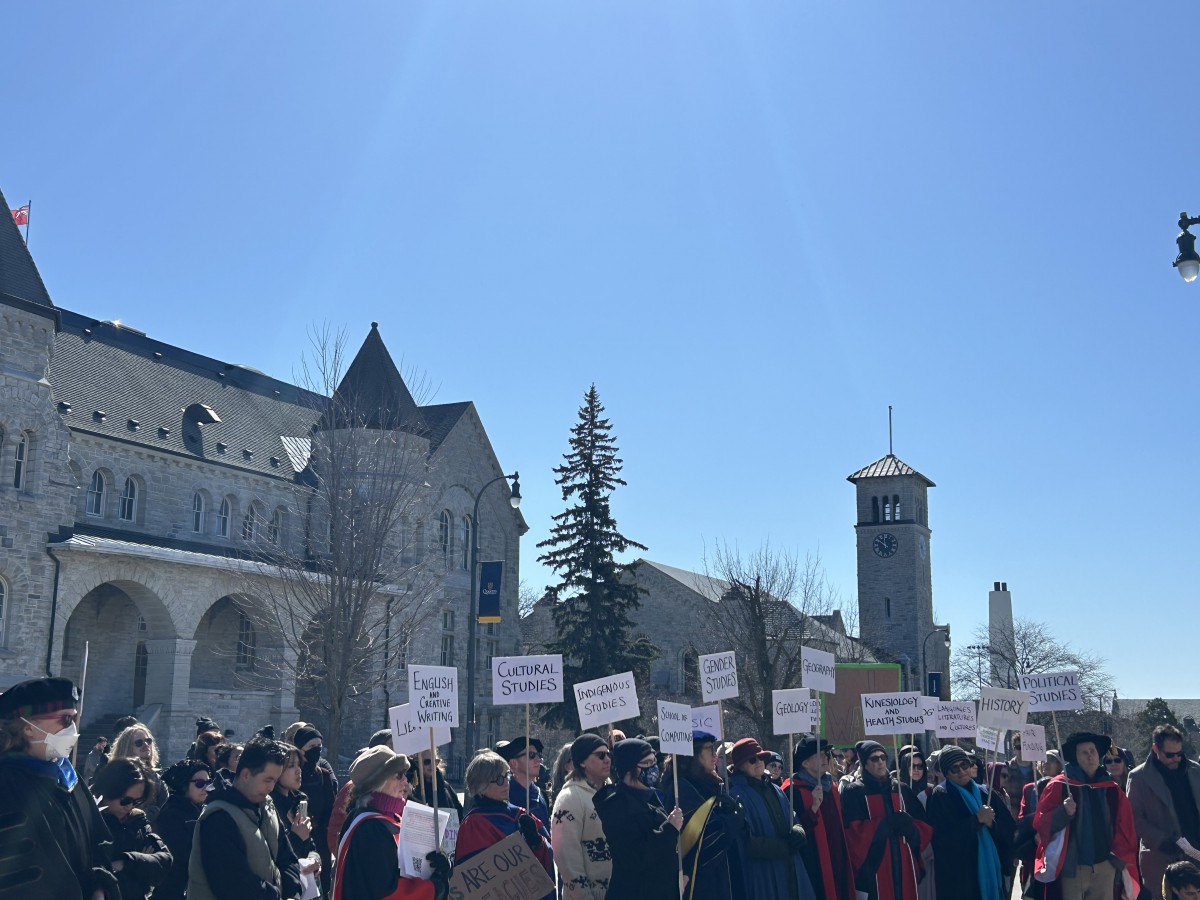
Caste-based discrimination is found globally, leading to international movements against this form of discrimination. In Canada, caste-based discrimination persists. Institutions of higher learning are not free from caste-based discrimination. In 2021, students at the University of California, Davis (UC Davis), found evidence of caste-based discrimination among students and self-organized to push the university to address caste-based discrimination. They were successful. UC Davis now formally recognizes caste as grounds for discrimination in its policies.
At Queen’s, we reached a ratified collective agreement after six weeks of labour action. As a result of picketing every day for six weeks in rain, sun, hail, and storms, we won a new collective agreement that guaranteed intellectual property recognition for research assistants, wage increases, and a streamlined grievance process that protects our members. These wins represent a small proportion of the reforms we had hoped for as a bargaining team, but we managed to win on caste-based discrimination, which is now grievable under the collective agreement. The language allows the union to hold the employer accountable for caste-based discrimination that our members experience in the workplace.
The letter of agreement (LoA) recognizing caste as grounds for discrimination is a landmark for our members, all of whom, as a collective, have fought alongside anti-caste discrimination grassroot organizations and activists for this LoA to be in our contract. This agreement was unprecedented; no other unions at Queen’s had a collective agreement that included caste as grounds for discrimination in the workplace. While cemented in place through the bargaining process, it took more than labour negotiation and action to arrive at this point. This success was a result of rigorous community education, organization, and mobilization that took place over the course of a year on a campus where many didn’t even know what a collective agreement was.
From the beginning
The organizing and mobilizing work for this LoA began under the leadership and guidance of Kavya Harshitha Jidugu, a Dalit Ph.D candidate at Queen’s and previous co-lead steward at PSAC 901. Jidugu was the founder of the Ambedkar Reading Circle at Queen’s, an anti-caste discrimination group that helped bring the issue of caste-based discrimination to the bargaining table. She is now the equity officer of the local.
I first learned about caste-based discrimination from Jidugu. As stewards, we were expected to attend Steward’s Council, a monthly meeting where union representatives discuss grievances and ongoing labour issues with the employer. This was also where I, along with other stewards representing graduate student workers employed in departments across the university, learned from Jidugu and her scholarship on caste-based discrimination and its effect in the diaspora.
Throughout six weeks of labour action, Mutual Aid Katarokwi-Kingston, in partnership with Labour for Palestine and PSAC 901, provided warm and delicious home-cooked meals to picketers. Photo provided by author.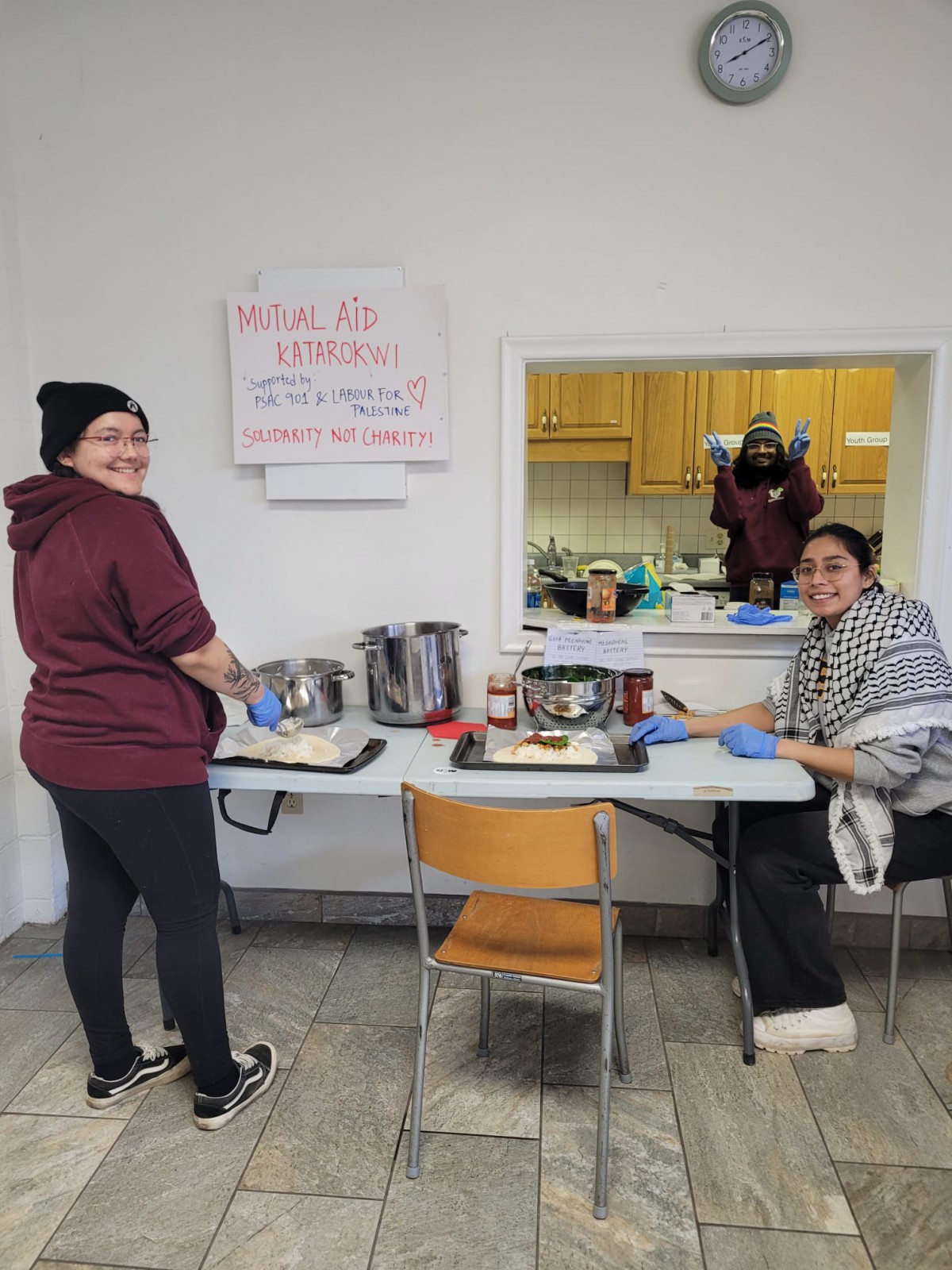
A union has to adapt to the diverse set of struggles its members carry, especially with a large number of our membership coming from South Asia as international students. This includes changing our approach to what labour encompasses. “All equity issues are labour issues when people are labourers,” asserts bargaining team member Li. “Caste is particularly important because [...] Harshitha’s research has shown that it’s an under-addressed but rampant form of prejudice and institution bias at the postsecondary level.”
Working with Jidugu, I put forward a motion in Steward’s Council to change the local’s internal statement of harassment to include caste as a protected ground against discrimination back in February 2024, a year before any negotiations took place.
“The union took it as an issue before the employer. We were already trying to implement something internally. The second step was to compel the employer to recognize it,”
remembers Szewczyk-El Jassem, who was also a member of the bargaining team.
Communal effort
Faculty, support staff, graduate student workers, and students came together and played their own parts in generating the momentum needed to get people talking about caste and the serious, global impact that caste-based discrimination can have. Following change within our union, the next task was to educate our employer about a form of discrimination that is virtually invisible to them.
“The uphill battle that we had, with just five people on the bargaining team on the opposing side, [was] trying to convince them that caste, a) exists, b) is actually important, and this kind of discrimination happens,” says Szewczyk-El Jassem.
Jidugu’s expertise and research was invaluable in this education campaign. In a negotiation session with the employer, she presented her research to help the employer understand the gravity of caste-based discrimination.
“One thing that Harshitha really tried to do is to decentre Canada and decentre Queen’s, and be like, ‘No, no, this is something that is beyond you. This is something that has existed for centuries. People die everyday because of casteism,’” says bargaining team member Njoroge. “Harshitha made sure that we understand that it is a global problem.”
The changing temperature among our membership in the strike also meant that we had to be tactical about what issues continued to be pressure points in negotiation.
Bargaining was not the only strategy that made policy changes happen. Simultaneous mobilization of grassroots organizations exerted additional pressure on the employer to accept that caste-based discrimination must be addressed institutionally. “There [was] a lot of other organizing happening. The bargaining definitely gave it a spotlight [and] we were conveyors for some of those things, but there were petitions from students [...] sent to the administration. And I think this is what was very good about the campaign,” said Szewczyk-El Jassem.
Without our community partners and organizers, I believe it would have been a harder, perhaps impossible, battle to have caste-based discrimination recognized at Queen’s. The union was a great instructor of policy reform that benefited workers, but a majority of the organizating efforts and tactical mobilization around caste fell to general members, who came together to fight for their collective rights.
Even so, the concern over caste-based discrimination was not shared by everybody in the membership. We had a diverse membership, and with that diversity came ideological differences when it comes to what counts as a labour issue. “It was a period of intense discussion and pushback,” recalls Njoroge.
Being on strike changed the landscape drastically for some members, and that shock was reflected in some withdrawal of support for issues not traditionally seen as labour issues.
“People became disillusioned by the harsh reality of the picket line,” Li remembers. “They folded very quickly [...] Naturally, people are going to have a lot more priorities before a strike than during.”
The changing temperature among our membership in the strike also meant that we had to be tactical about what issues continued to be pressure points in negotiation. The circumstances – an increasingly burnt-out picket line and an antagonistic university administration that continued to use delay tactics and misinformation to fuel mistrust within the campus community – necessitated a strategic manoeuvre from the bargaining team.
From article to LoA
The bargaining team’s initial plan was to have caste added as a protected ground against discrimination. In our collective agreement, anti-harassment and anti-discrimination fell under the jurisdiction of Article 20. We originally drafted a proposal for “caste” to be added to this section.
As pressure mounted and the strike went on, our priorities had to change. The team had to weigh the physical, emotional, and psychological toll of the picket line alongside trying to negotiate with an employer who would rather spend money hiring private security to surveil us than come back to the bargaining table.
The employer continued to reject our proposal for caste to be added within the collective agreement, citing that other grounds of protection already covered caste due to “intersectionality.” Their statement was made public to our members, as the bargaining team was engaged in transparent, semi-open bargaining through a live tracker on our website. This became an excellent conversation starter on the picket line that helped our members to understand the level of frustration the team encountered every time we headed to the table.
Instead of accepting our proposal, the employer came back with a LoA on caste. I can still remember the moment the team saw the LoA on the table. Months prior, we had explicitly stated to the employer that we wanted to avoid LoAs in case they were overlooked by members because of their placement as an appendix to the collective agreement, as opposed to within its body.
Yet, as tension continued to mount and our members experienced unprecedented levels of burnout and intense surveillance on the picket line, the team decided that an LoA would be a strong stepping stone to have caste introduced to the collective agreement. We strengthened the language in the LoA so that members reading it would understand that caste-based discrimination is now grievable.
The mental shift to accepting the LoA as a team came unanimously, as we saw it as a platform for future bargaining teams.
“LoA is a way to normalize something without fully normalizing it,” explains Szewczyk-El Jassem. “Queen’s was ready to take a step, but it was not ready to keep it in the main body of the collective agreement, even though [LoAs] are as grievable as the main body of the collective agreement.
“Since we don’t have an expiry date on this LoA, it essentially became part of the collective agreement indefinitely.”
What comes next
As with many labour rights issues at the workplace, the scale is often tipped against workers. That is also the case in terms of enforcing this new LoA.
“I don’t think we really convinced [the employer that caste discrimination] actually exists,” laments Szewczyk-El Jassem. “How much work would it be on folks who are already experiencing this discrimination?”
As a bargaining team, we see this LoA as a win, but for a different reason.
“I am of the opinion that it is more of a victory for the members to believe that their union is treating it as a serious issue and making efforts as a union institution to become educated on it so that union officers can better represent and protect workers, rather than assuming that the institution will bear the burden,” Li explains.
Even though we compelled the university to recognize caste-based discrimination through union labour action, we still have much work to do. What comes next is the hard work of enforcing this LoA to ensure it does not fall into obscurity. It is not up to the university to protect us; we protect us.
“This is everybody’s job to figure out what does it mean now that we have put this [language] in the collective agreement? How do we make sure that all the 14 executive members understand? Everybody should be familiar with this,” says Njoroge.
Community involvement was what helped us win this fight, and it will continue to be key in sustaining the enforcement of this LoA. Li explains, “There’s an action fit for every aspect and every role of the individual that is able to move things forward.
“Bargaining isn’t the only time that a labour union can power change over the workplace.”
While bargaining for our local union has now concluded, it is not the end of activism against caste-based discrimination. As my colleagues pointed out, advocacy work continues beyond PSAC 901, beyond Queen’s, and beyond Canada, as caste-based discrimination continues to affect the lives of millions across the globe. It is a win for us here at PSAC 901 to have this LoA, but we owe it to ourselves and our colleagues to push for more, within and outside of collective bargaining.
The workers, united, will never be defeated.