Tags – War

  • From worker to worker

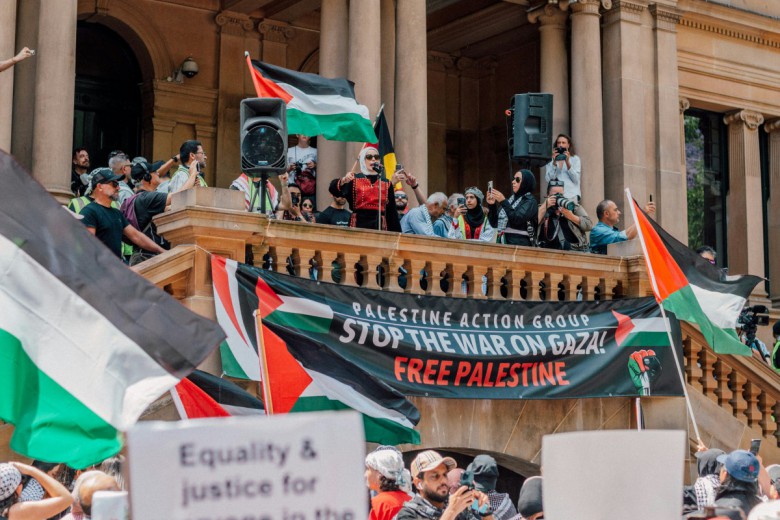
    Labour solidarity with Palestine

    Since the 2005 call for solidarity from Palestinian trade unions and civil society organizations, unions all over the world have responded with resolutions and actions to break ties with Israel’s apartheid regime.

  • “The best game you can name”

    Hockey is no stranger to militarism, but radical fans aren’t about to call the game

    Fifteen thousand people pack the seats of the sold-out MTS Centre in Winnipeg. They cheer wildly as the home team Jets rush the puck up through the neutral zone. Cheers erupt louder still as shots are fired on goal, bodies slammed brutally into boards, and pucks are buried deep in the visitor’s net.

  • Open for business

    Imperial intervention has pried Afghanistan open for foreign investment

    Afghanistan, and the surrounding region, has been in the crosshairs of imperial expansionists for centuries. In 1600, Queen Elizabeth I set the East India Company on its march northward through India. This expansion of the British empire was confronted in Afghanistan in the early 19th century by the southward expansion of the Russian empire, instigating a series of wars known as the “Great Game.”

  • Our way to fight

    Book review

    In this book, you’ll meet Palestinians and Israelis whose struggles for peace, justice and an end to more than half a century of illegal dispossession and brutal occupation, belie the racism and harmful homogenising of history that fuel the current policies of the Zionist state.

  • Hierarchies of worthiness

    Women and victimhood in the Canadian media

    In news coverage of violence, women are almost always portrayed as victims. Whether they are worthy, innocent victims in need of rescue (“virgins”), as in the case of Afghan women post-9/11, or unworthy, culpable victims to be ignored or incarcerated (“vamps”), as with Indigenous women in Canada, depends on their strategic value to the forces in power.

  • Lives less livable

    Judith Butler on expanding queer solidarity beyond sexuality

    Butler’s theory of gender-as-performance remains her best-known contribution to academia, but for the last decade her attention has gradually shifted from gender to the politics of war. Now she’s struggling with questions like, whose deaths matter, and why are some deaths grievable but others not?

  • Letter from the editor

    Nationalism as pathology

    George Orwell wrote that in a time of universal deceit, telling the truth can be a revolutionary act. Similarly, in an age of lies-passed-off-as-truth (the propaganda model), truth-passed-off-as-lies (satire) has a power all its own.

  • Walking backward into battle

    How Canada’s civilian and military deep integrationists took us to war

    It was well after midnight when we got off the yellow school buses and stepped into a field of thick Alberta mud. The sides of the large field kitchen tents nearby were billowing in the cold wind. Our kit had just been chucked to the ground from the buses, each item landing with a wet thump. Maple Defender, a week-long training exercise, was designed to give us a taste of the war in Afghanistan, as far “down in the weeds” as it was possible to get without actually being there.

  • Unfinished business

    Sweatshops, oligarchs and the fear of a new constitution in Honduras

    For the last 10 years, Juana López Nuñez (not her real name) has spent most of her waking hours making T-shirts for the Canadian company Gildan Activewear at the company’s San Miguel factory in Honduras. Today, at age 44, she has little use of her arms and experiences constant pain in her shoulders, neck and hands. She takes painkillers throughout the day, and has had one surgery, which didn’t ease the chronic tendonitis that keeps her up at night.

  • Canada’s black book

    Book review

    The Black Book of Canadian Foreign Policy
    Yves Engler
    Fernwood, 2009

    It is commonplace even for critics of Canada’s role in Afghanistan and Haiti or of its vocal support for Israel’s recent military campaigns in Lebanon and Gaza to suggest that Canada has abandoned a long-standing tradition of being an honest broker in international politics, nurturing the idea that there is a mythical past in which Canada was an even-handed arbitrator of international conflict.